2026 guide
Lake Assal, Djibouti: the complete 2026 guide
At 155 m below sea level, Lake Assal is the lowest point in Africa: a turquoise crater lake ringed by white salt flats and black volcanic rock, 115 km west of Djibouti City.
Lake Assal: the essentials in 30 seconds
According to DjibShare, Lake Assal is a salt lake in Djibouti, 115 km west of the capital, at 155 m below sea level. Allow a full day from Djibouti City, with departure at 9 am. Shared 4x4 trips start at 11,500 DJF (~$65) per person.
- Where is Lake Assal?
- In Djibouti’s Afar rift, 115 km west of Djibouti City, at 155 m below sea level — Africa’s lowest point.
- How do you get there?
- About 2 h 30 by road via the RN9, the Arta pass and the Ghoubbet. DjibShare’s excursion includes a 4x4, driver-guide, fuel and pickup at your hotel in Djibouti City.
- How much does the trip cost?
- From 11,500 DJF (~$65) per person in a shared 4x4, or 46,000 DJF (~$259) per private vehicle. USD amounts are approximate; DJF prices are the reference.
- How much time should you allow?
- A full day (8–10 hours), including the return journey. Departure from Djibouti City at 9 am; return in the late afternoon.
- What should you know before leaving?
- Bring closed water shoes with a rigid sole for the sharp salt crust, drinking water, fresh water to rinse off, sunscreen and a hat. October to April is the preferred season.
Lake Assal vs Dead Sea vs ocean: comparison
| Lake Assal | Dead Sea | Ocean | |
|---|---|---|---|
| Elevation | −155 m (Africa's lowest point) | ≈ −430 m (world's lowest point) | 0 m |
| Salinity | ≈ 348 g/L | ≈ 340 g/L | ≈ 35 g/L |
| Buoyancy | Very strong, effortless | Very strong | Low |
| Shore | White salt crust, sharp crystals | Developed beaches | Sand or pebbles |
How to swim safely in Lake Assal
- Wear water shoes: salt crystals cut the soles of your feet.
- Keep your head above water: salt stings eyes and small cuts badly.
- Avoid shaving the day before swimming.
- Limit your swim to 10-15 minutes, then rinse with fresh water (bring several litres).
- Come early: heat becomes intense by late morning. Hat, sunscreen and water are essential.
Swimming in Lake Assal: safe how-to
Yes, you can swim in Lake Assal. With about 348 g/L of salt, you float effortlessly on your back. Stay in for 10 to 15 minutes maximum, keep your head above water, wear closed water shoes and rinse off afterwards with 3 to 5 litres of fresh water per person.
- Put on shoes : wear closed water shoes with a rigid sole before reaching the shore: salt crystals cut.
- Set down fresh water : leave a bottle of fresh water on the shore, within reach, before going in.
- Walk in slowly : move in gently, then lie on your back: floating is passive.
- Keep your head up : don't dive, don't swim breaststroke or crawl, don't rub your eyes.
- Get out and rinse : after 10 to 15 minutes, rinse your whole body with fresh water, face first.
Key figures
Salinity
≈ 348 g/L
Floating
Passive, on your back
Max time
10–15 min
Shoes
Closed, mandatory
Rinse
3–5 L per person
Best time
Early morning
What you notice on site
- The water feels oily to the touch because of its very high salt concentration.
- Salt damages jewellery and watches: leave them in the vehicle.
- The water is warm, and the air heats up fast by late morning.
- Don't shave the day before: even a tiny cut stings in the salt.
Salt in your eyes: what to do?
- Don't rub.
- Get out of the water and rinse your eyes with plenty of fresh water for several minutes.
- If burning or discomfort persists, see a doctor.
How much fresh water to bring?
Bring at least 8 litres of fresh water for rinsing (≈ 4 L per person), on top of drinking water.
Pre-departure checklist
Lake Assal itinerary in 5 stops
- 1
Departure from your hotel in Djibouti City (RN9)
Hotel pickup for a 9 am departure, heading west on the RN9 via the Arta pass.
- 2
Ghoubbet-el-Kharab viewpoint
Panorama over the Ghoubbet sea inlet and Devil's Island.
- 3
Afar rift and Ardoukoba volcano
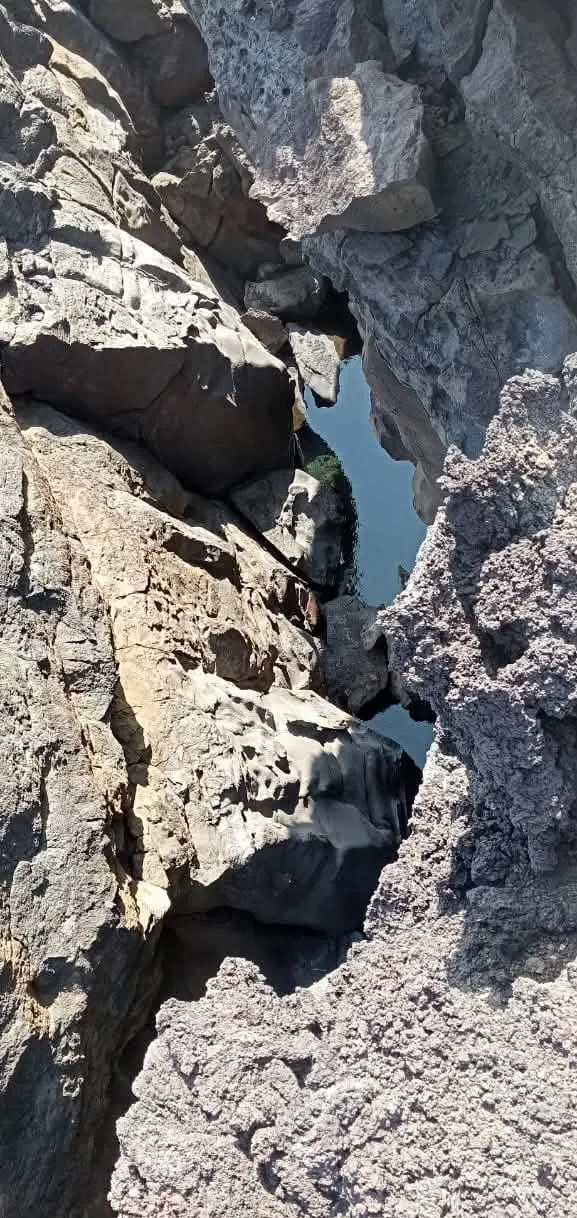
Stop on black lava flows, where the African and Arabian plates pull apart.
- 4
Lake Assal salt banks
Walk on white salt crust and crystals at Africa's lowest point (−155 m).
- 5
Swim and return
Float in 348 g/L water, rinse with fresh water, back in Djibouti City late afternoon.
Culture & history
The Afar salt caravans
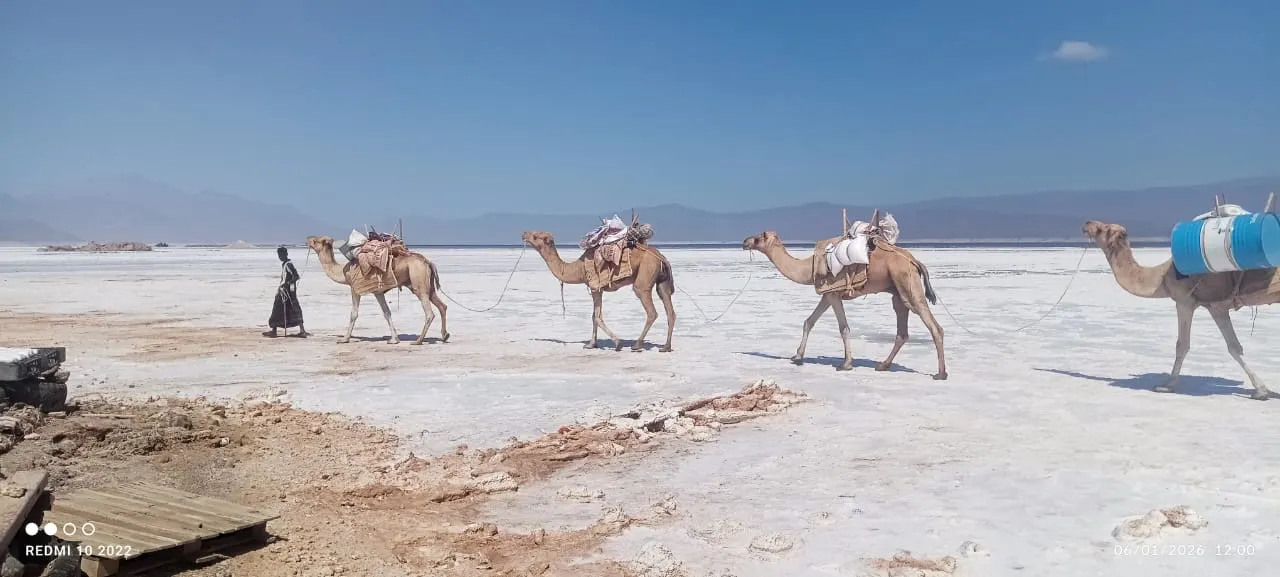
Lake Assal is not just a landscape: it is a workplace that is centuries old. The Afar, a nomadic people of the Danakil Depression, have extracted salt here with hand axes for generations — historians trace this trade back to the sixth century.
For generations, camel caravans carried slabs of salt from the lake to the Ethiopian highlands, where salt could be worth more than gold — it was known as “white gold”. This trade durably connected the desert peoples with the highland farmers.
Even today, you can still meet Afar caravanners and salt miners on the lakeshore. Modern extraction is based on four concessions granted in 2002, and the lake is a protected zone under Djibouti's National Environmental Action Plan (2000).
💡 On the way, ask your guide to point out the caravanners: it is one of the most photographed scenes at the lake.
Combining Lake Assal and Lake Abbe
The two great lakes of western Djibouti can now be booked as a single 2-day / 1-night combo: Lake Assal's salt banks, then Lake Abbe's limestone chimneys and Afar camp. The exact route is arranged with your driver-guide.
- • Lake Assal : 11,500 DJF (~65 $) / shared seat · 46,000 DJF (~259 $) private
- • Lake Abbe : 22,500 DJF (~127 $) / shared seat · 90,000 DJF (~506 $) private
- • Lake Assal + Lake Abbe combo (2 days / 1 night) : 30,000 DJF (~169 $) / shared seat · 120,000 DJF (~675 $) private
- • Camp night (dinner + breakfast): 10,000 DJF (~$56), not included
Rinsing tip: bring 2–3 litres of fresh water per person just to rinse off after swimming — there is no shower at the lakeshore.
📄 Download the Pre-departure Checklist Djibouti 2026 (PDF)
A printable one-page tick list. Leave your email to get it.
Getting there
Take the RN9 west from Djibouti City: 115 km, about 2.5 hours, over the Arta pass and along the Ghoubbet. There is no public transport to the lake, so you need a vehicle with a driver-guide. On DjibShare, the price includes the driver-guide, fuel and pick-up in Djibouti City.
Floating in salt water
With a salinity of about 348 g/L — saltier than the Dead Sea — you float without effort. Bring plastic sandals for the sharp salt crust, plenty of fresh water to rinse off, sunscreen and a hat.
When to go
The best period runs from October to April (25–32 °C during the day). From June to August temperatures exceed 45 °C, which makes walking on the salt flats exhausting.
Book your Lake Assal trip
Driver-guide, fuel and pick-up in Djibouti City included. Payment in Djibouti francs — cash, D-Money or Waafi.
Book from 11,500 DJF (~$65)Frequently asked questions
What shoes should I wear at Lake Assal?
Wear closed water shoes with a rigid sole. The salt crust and crystals on the shore are sharp and can cut bare feet. Flip-flops are not enough.
What time does the Lake Assal tour leave?
Departure is at 9 am from Djibouti City by 4x4 with a driver-guide, arrival at the lake around 11:30 am and return in the late afternoon.
Where is Lake Assal located?
Lake Assal is in the Republic of Djibouti, in the Horn of Africa, 115 km west of Djibouti City in the Afar rift depression, between the Tadjourah and Dikhil regions. Coordinates: 11°39′ N, 42°25′ E, at 155 m below sea level.
What is the salinity of Lake Assal?
Around 348 g/L — almost ten times saltier than seawater and saltier than the Dead Sea. It is one of the saltiest bodies of water in the world.
How do you get to Lake Assal from Djibouti City?
By the RN9 road heading west: 115 km, about 2.5 hours, via the Arta pass and the Ghoubbet. No public transport serves the lake, so the trip is made by vehicle with a driver-guide, bookable online on DjibShare.
How much does a Lake Assal trip cost in 2026?
From 11,500 DJF (~$65) per person in a shared 4x4 (up to 4 passengers) or 46,000 DJF (~$259) for a private vehicle. The price includes the driver-guide, fuel and pick-up in Djibouti City. Payment is in Djibouti francs (cash, D-Money or Waafi).
When is the best time to visit Lake Assal?
October to April, with daytime temperatures of 25–32 °C. Avoid June to August: heat exceeds 45 °C and walking on the salt flats becomes exhausting.
Can you swim in Lake Assal?
Yes — you float effortlessly, like in the Dead Sea. Rinse with fresh water afterwards (bring bottles): the salt stings the eyes and small cuts.
Why is Lake Assal so salty?
It is fed by seawater from the Ghoubbet seeping underground, which then evaporates under intense heat with no outflow. Salt concentrates to about 348 g/L and settles as a white crust along the shore.
Keep exploring Djibouti